


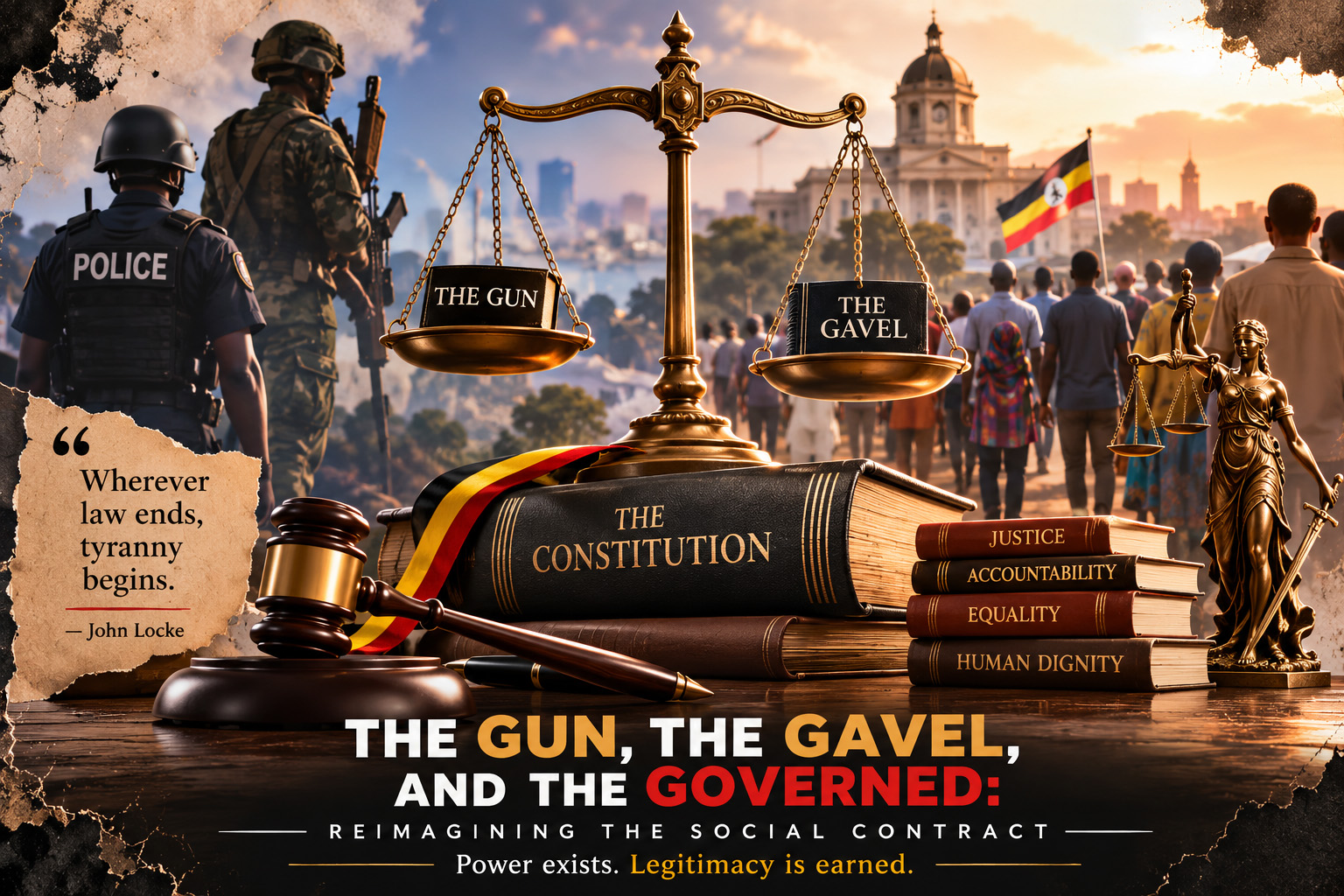
The modern state is founded upon a paradox. It is simultaneously the guardian of liberty and the holder of coercive power. It protects rights through institutions of law while maintaining armies, police forces, and security agencies capable of restricting those very rights. This paradox has occupied political philosophers for centuries, but perhaps none addressed it more profoundly than John Locke in his Social Contract theory.
Locke’s conception of government was not one of domination but of trusteeship. Political power, in his view, originates not from divine authority, military conquest, or the whims of rulers, but from the consent of the governed. Citizens surrender part of their natural liberty in exchange for protection of life, liberty, and property. The state therefore becomes a fiduciary institution where trustees hold power on behalf of the people.





This Lockean understanding raises an enduring question for contemporary constitutional democracies, if the people are the source of authority, why does power often appear concentrated in a few hands? More importantly, how should police, military, and executive institutions exercise such power without undermining the very social contract that legitimizes their existence?
The answer lies in the relationship between law and force. The state may possess the gun, but the legitimacy of that gun depends upon law. Once force ceases to serve law, the social contract begins to fracture.
John Locke rejected the absolutist theories that characterized much of seventeenth-century Europe. In his Second Treatise of Government, he argued that political society emerges because individuals seek security for their natural rights.
For Locke, governments are established not to dominate society but to serve it. Authority is therefore conditional. It exists only so long as it advances the common good.
The concentration of power in the executive branch is not inherently problematic under Lockean thought. Indeed, some degree of concentration is necessary for effective governance. Decisions regarding security, public order, disaster response, and national defence often require speed and coordination that diffuse institutions cannot provide.
However, Locke emphasized that concentrated power must always remain limited by law. Executive authority is legitimate only when exercised for public welfare rather than personal or political advantage. Political power is therefore a trust, not a privilege.
This distinction remains central to contemporary debates on governance. The issue is rarely whether power exists, no the issue is whether power is exercised for the purposes for which society entrusted it.
The social contract is not merely about preventing chaos. It is also about creating conditions in which citizens can flourish.
A state faithful to Lockean principles must guarantee more than security. It must pursue justice.
Social justice, in this context, entails the fair distribution of opportunities, equal protection of the law, and meaningful access to public goods. Citizens surrender certain freedoms because they expect the state to secure conditions under which they can exercise their remaining freedoms effectively.
A government that protects property while neglecting education, healthcare, equality before the law, and access to justice performs only half of its contractual obligation.
Modern constitutional democracies therefore increasingly recognize social justice as an extension of the social contract. Human dignity becomes not merely a moral aspiration but a constitutional expectation.
The legitimacy of government consequently depends not only on elections but also on outcomes. Citizens judge governments by whether public institutions deliver justice fairly and consistently.
Democracy represents the procedural manifestation of Locke’s social contract. Elections, representative institutions, judicial review, and constitutional limitations exist to ensure that the government remains accountable to the people.
Yet democracy is more than periodic voting.
A state may conduct elections while simultaneously weakening constitutional restraints, suppressing dissent, or concentrating excessive authority within the executive. Such a state preserves democratic form while eroding democratic substance.
Professor Busingye Kabumba has consistently argued that constitutionalism requires more than the existence of a constitution. It requires fidelity to constitutional principles and limitations on public power. His writings caution against reducing constitutional governance to mere formalism while ignoring the values that sustain it. has warned against what he describes as “presidentialism”, the tendency for political systems to concentrate authority excessively in the executive. He argues that democratic constitutionalism suffers when institutions become subordinate to individuals rather than remaining autonomous guardians of public accountability. often emphasized the necessity of security as a prerequisite for national development. Security indeed remains a foundational public good. Without order, rights become difficult to exercise. Without stability, democratic institutions struggle to function.
However, security divorced from legality becomes coercion.
The police officer and the soldier are constitutionally empowered not because they carry weapons but because the law authorizes them to carry weapons on behalf of