


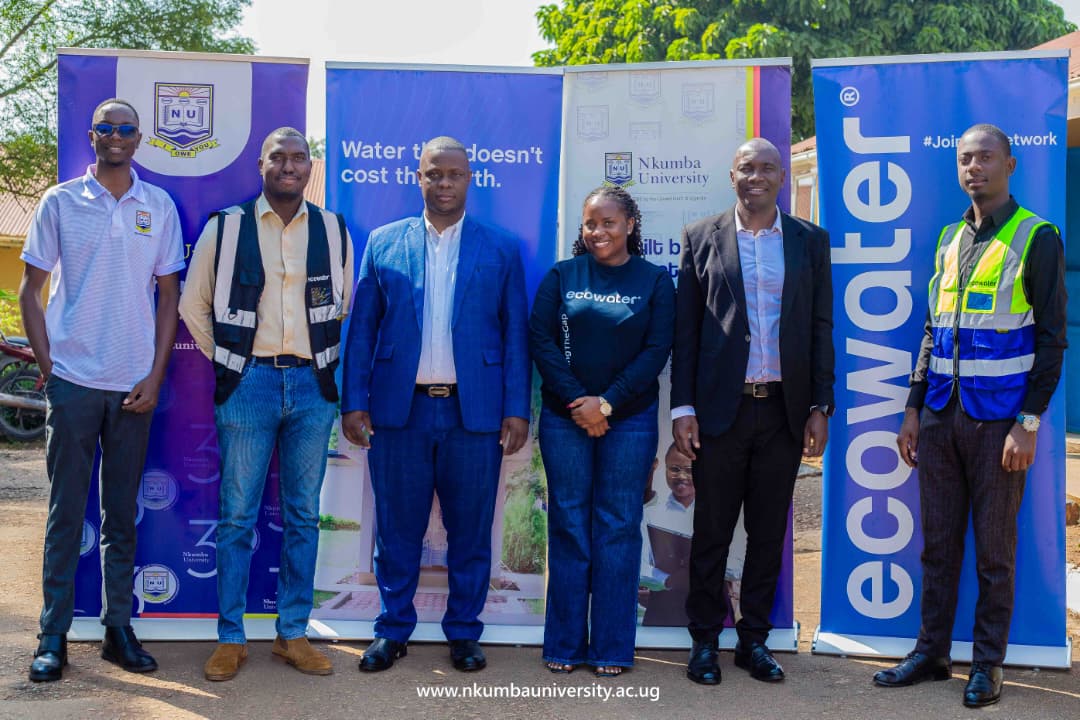
Nkumba University is set to enhance access to safe drinking water for its students after opening discussions with Eco Water, one of Africa’s leading water refill companies, to establish an IoT-enabled water refill station, first at the university’s main campus.
The proposed partnership, discussed on Thursday 30th July 2026 at the university, seeks to introduce a self-service, technology-driven water refill system that will provide students with affordable, safe drinking water 24/7.




The automated water station is designed with tamper-proof technology and built-in IoT sensors that continuously monitor and manage the purification process without human intervention. The system dispenses water through a cashless smart card Fintech.
Under the proposal, Nkumba University will provide a 25-square-metre outdoor space with access to water and electricity, designate a liaison officer to coordinate implementation, and mobilize students to embrace the safe water refill programme.
Students will be able to refill reusable bottles at a cost of Shs300 per litre, eliminating the need for disposable plastic water bottles.
Speaking during the engagement, the Deputy Vice Chancellor, Dr. Sulaiman Bbosa, said the initiative aligns with the university’s commitment to improving student welfare while promoting responsible environmental stewardship. “This initiative will not only respond to the growing demand for safe and affordable drinking water for our students but will also strengthen the university’s efforts towards plastic waste reduction and management,” Dr. Bbosa said.
He added that the university had studied the model’s success in other higher institutions of learning and was convinced it would benefit Nkumba students. “We have engaged and believe this is the right path. The system has been implemented and tested in other universities, and it is now the right time for our students to enjoy similar services. With its affordable cashless refills operating 24 hours a day and a plastic-free approach, we are not only quenching students’ thirst but also reducing the overwhelming use of single-use plastic water bottles,” he said.
Representing Eco Water, Brenda Ahurira said the company’s vision extends beyond supplying drinking water to promoting sustainable consumption through innovation. “Our systems are based on a refill model that is completely plastic-free. We intend to eliminate single-use plastics in institutions, especially universities and other highly populated areas,” she said.
Brenda explained that the refill stations employ internet-enabled technology to guarantee efficiency, safety and reliability. “Our machines are IoT-enabled. We use technology to drive innovation. Water is dispensed through smart refill machines using cashless smart cards, and students can choose between chilled and room-temperature water,” she said.
She noted that the technology is already operational in several higher institutions, including Makerere University Business School (Nakawa Campus), the Islamic University in Uganda’s Kampala and Mbale campuses, and Mbarara University of Science and Technology, where it has significantly improved access to safe drinking water while reducing plastic waste.
With rising concerns over plastic pollution and the cost of packaged drinking water, refill-based systems are gaining traction as practical alternatives that support both public health and environmental conservation.
Nkumba University has in recent years intensified investments in sustainable infrastructure and digital innovation as part of its broader strategy to enhance the student experience while contributing to national and global sustainable development goals. The planned IoT-enabled water refill station would further reinforce the university’s commitment to innovation, environmental responsibility and student-centred service delivery.
Eco Water had attempted to establish the dispenser last year, but the initiative stalled. Progress was revived when the President of the Law Society, Edwin Kamara, reached out to Eco Water and initiated fresh discussions that ultimately paved the way for the project’s potential implementation.

