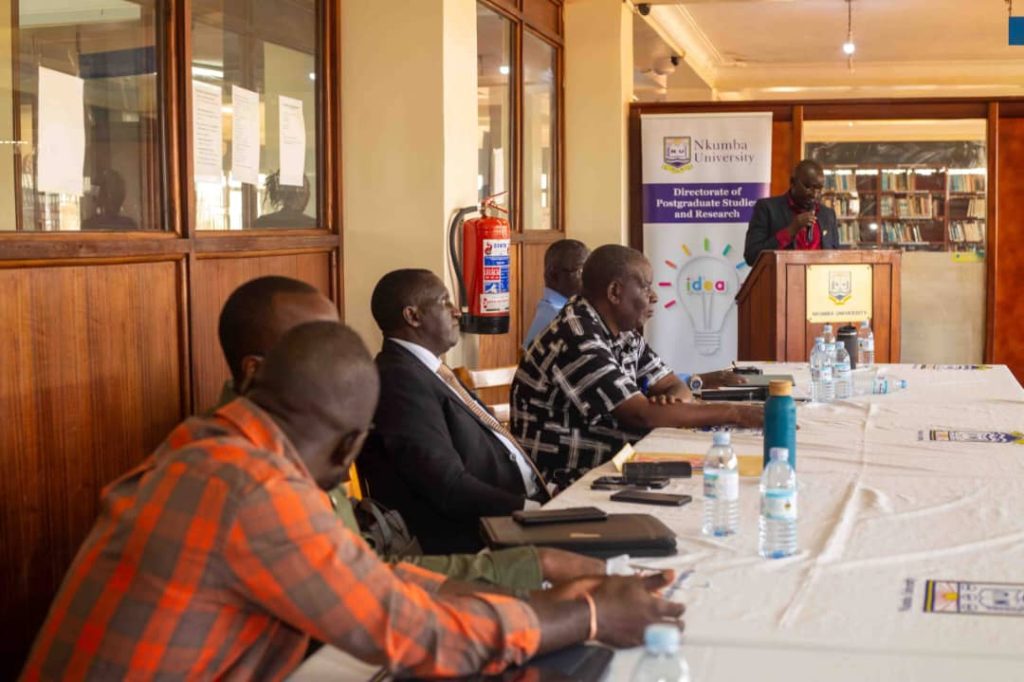


Uganda’s elections remain heavily securitized, a panel of experts warned at the 4th National Security Studies Conference held today at Nkumba University, under the theme, “Demands and Expectations in an Election Period.”
Organized by the Security Studies and Analysis Center, the conference brought together scholars, security analysts, and political leaders to examine the challenges facing the country ahead of the 2026 elections.





Mwambutsya Ndebesa, a leading analyst on electoral security, opened the discussions by highlighting the militarized nature of Uganda’s polls. “Elections here operate under fear, extraordinary force, and the constant framing of opposition as a threat,” he said. Drawing parallels from Uganda’s history, from 1961, 1962, 1980, to the NRM era, Ndebesa argued that political intimidation is a recurring pattern. “What we see is negative peace: order without justice. Civil society often reinforces this narrative of ‘peace at all costs,’ while ignoring injustice,” he warned.
He called for immediate reforms, recommending the reduction of military and police presence during elections and framing opposition as legitimate political competitors rather than enemies of the state. He further urged strengthening democratic institutions, promoting equality, dismantling illegal militias such as crime preventers, and fostering transparent communication to restore public trust in electoral processes.
Benjamin Katana, Deputy Treasurer at the National Unity Platform (NUP), sounded similar alarms. “Our security forces, constitutionally non-partisan, have become politicized,” he said. Katana cited cases of opposition figures being intimidated, surveilled, and, in some instances, tortured. He also highlighted the rise of irregular paramilitary groups, worsening lawlessness and fear. “If this continues, Uganda risks repeating historical crises of instability,” he cautioned.
Katana recommended reorienting the security sector toward professionalism, holding officers accountable for partisan actions, dismantling irregular armed groups, and enhancing parliamentary oversight. Civic training for security officers and investment in community policing were also high on his list of priorities.
Christopher Lwanga of the Uganda People’s Congress traced the roots of political instability to unresolved historical divisions at independence. “Pre-1962 politics were fragmented and exclusionary. Traditional institutions, such as Buganda, resisted national processes, weakening cohesion,” he said. According to Lwanga, the legacy of this exclusion continues to squeeze and manipulate citizens rather than empower them.
He called for a national dialogue to address historical grievances, the promotion of multiparty cooperation, and reconstruction of national identity frameworks that bridge traditional and modern governance. “Political parties must adopt long-term nation-building agendas, not just strategies for election cycles,” Lwanga emphasized.
Prof. David Isimba described what he termed an “electro-paralytic mechanism” in Uganda’s electoral system—a recurring paralysis embedded since colonial rule. “Colonial-era policies, such as the 1955 District Councils Ordinance, created permanent political minorities and majorities. Universal suffrage was introduced within unfair structures, limiting genuine democratic participation,” he explained. He noted that systemic securitization has continued through elections in 1962, 1980, and even 2021.
Isimba recommended structural reforms that address historical inequalities, demilitarizing elections, rebuilding electoral systems on fairness, and introducing independent audit mechanisms. “We must rely on data-driven reforms informed by political history, not short-term interests,” he stressed.
Dr. Stephen Kizza, from the Internal Security Organization (ISO), emphasized the interdependence of security and democracy. “Elections require stability, rule of law, and public confidence. Security is an ecosystem—encompassing institutions, communities, information networks, and technology,” he noted. He warned that misinformation now dominates the electoral landscape, shaping public perception and heightening tensions.
Kizza called for transparent communication, community-based security approaches, non-violent crowd management training for officers, and strengthened inter-agency coordination. “Public trust is the foundation of effective security,” he said.