



The Steering Committee of the Nkumba University Rotary WASH Institute (RoWASHI) convened yesterday 17th March 2026 at Nkumba University to chart the way forward following the long-awaited approval of a Rotary Global Grant.
The meeting which focused on laying first stage implementation plans highlighted the power of international partnerships and long-standing Rotary efforts in delivering impactful community projects.




In her submission, District Governor, Christine Kawooya lauded the collective effort that made the WASH Institute a dream come true, emphasizing the importance of persistence and teamwork throughout the grant acquisition process. “This achievement reflects the commitment, resilience, and unity of our members who remained focused on the bigger picture of community transformation,” she said. “Each contribution, regardless of scale, played an important role in helping us secure this land mark opportunity.”
She also extended special appreciation to Nkumba University for playing host to the Institute, noting that the partnership demonstrates the university’s growing role in supporting practical community development initiatives. “By providing space for this centre, Nkumba University has demonstrated its belief in partnerships that create lasting change beyond the classroom,” she added.
Setting the context of the initiative, Past District Governor (PAG) Peace Taremwa delivered a historical overview of the Rotary WASH Institute, explaining that it is envisioned as a Centre of Excellence for Water, Sanitation, and Hygiene in Africa.
He noted that the concept builds on Rotary’s decades-long global commitment to disease prevention, clean water access, and sanitation improvement. “RoWASHI is not just a project but a vision for Africa,” she expounded. “It is designed to become a knowledge hub that supports research, innovation, and practical solutions to WASH related challenges.
Historically, Rotary has played a significant role worldwide in WASH interventions, particularly through its Global Grants program which supports high-impact, community-driven projects. The establishment of RoWASHI is therefore seen as a natural progression of these efforts, bringing technical expertise, academic collaboration, and community service into one coordinated platform.
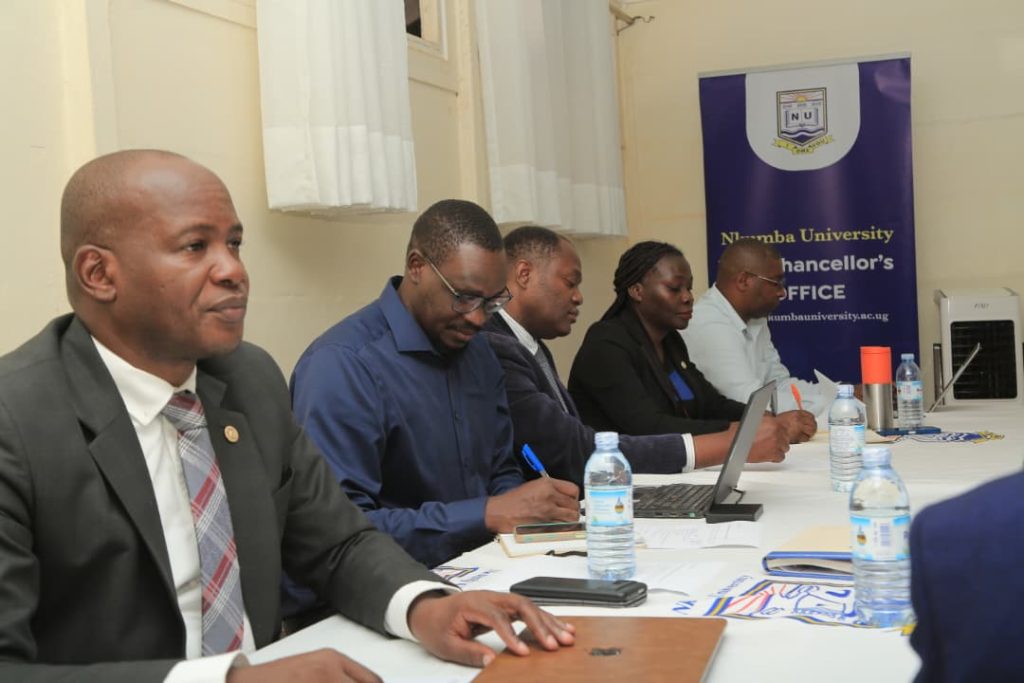
Nkumba University’s Vice Chancellor, Prof. Jude Lubega, reaffirmed the institution’s readiness to support the implementation phase, describing the partnership as mutually beneficial to both the university and the wider community. “As a university, we are committed to supporting initiatives that combine academic knowledge with practical solutions to societal challenges,” he said. “We see RoWASHI as an important platform for research, training, and community outreach.”
During the meeting, PAG Bush guided members through the operational aspects of the approved grant, outlining key action points necessary to ensure accountability, effective execution, and sustainability. “The approval of the grant is only the beginning,” he noted. “Our focus now must be on implementation discipline, transparency, and ensuring that the intended beneficiaries receive measurable value from this investment.”
Members discussed governance structures, monitoring mechanisms, and strategies for maintaining the long-term viability of the institute. Participants agreed that the initiative represents more than infrastructure development, but rather a model of how partnerships between service organizations and academic institutions can address pressing development challenges.
As RoWASHI enters its implementation phase, stakeholders remain confident that the project will stand as a model for sustainable WASH programming in the region and beyond.