


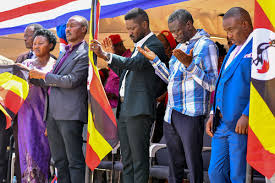
As Uganda approaches the general elections scheduled for January 15, 2026, the political atmosphere in December 2025 is thick with the tension of unfulfilled transitions and a complex legal struggle between the state’s coercive machinery and the constitutional rights of its citizens. The period has been defined not merely by the routine of campaigning, but by a profound constitutional crisis regarding the role of the military in civilian politics and the sanctity of the judicial process. While the National Resistance Movement (NRM) seeks to extend President Yoweri Museveni’s four-decade tenure, the political landscape is fractured by internal succession battles, particularly the rise of the Patriotic League of Uganda (PLU), and the systematic encirclement of the opposition National Unity Platform (NUP) through lawfare.
The “Muhoozi Project” and the Constitutional Conundrum of Military Neutrality:





The most defining feature of the current political period is the conspicuous fusion of the Uganda Peoples’ Defence Forces (UPDF) with partisan political activity. This phenomenon centers on the dual role of General Muhoozi Kainerugaba, who, as of late 2025, serves as the Chief of Defence Forces (CDF) while simultaneously presiding over the Patriotic League of Uganda (PLU), a political pressure group with clear ambitions for the presidency. This duality presents a direct challenge to Article 208(2) of the Constitution of the Republic of Uganda, 1995, which mandates that the UPDF shall be non-partisan, national in character, patriotic, professional, disciplined, productive, and subordinate to the civilian authority.
The statutory violation is further compounded by Section 99 of the UPDF Act, 2005, which explicitly prohibits serving military officers from engaging in active politics. The continued political rallies held by the PLU under the leadership of a serving CDF have rendered these statutory provisions ostensibly nugatory. Legal scholars point to the precedent set in Rtd Col. Dr. Kizza Besigye v. Attorney General, where the courts historically grappled with the limits of military officers’ freedom of expression versus the necessity of military discipline. However, the current scenario differs significantly; it is not merely expression but active mobilization. The failure of the state to invoke Section 16 of the Political Parties and Organizations Act, 2005, which restricts public officers and military personnel from holding office in political organizations, signals a suspension of the rule of law in favor of political expediency.
Furthermore, the “abeyance” of the transition whereby Gen. Muhoozi did not retire in time for the September 2025 nominations, has not dampened the militarization of the political space. Instead, it has shifted the “Muhoozi Project” from an immediate electoral bid to a succession strategy, utilizing the military structure to consolidate influence. This creates a constitutional crisis where the army is no longer just a guarantor of security but a central political player. The precedent in General David Tinyefuza v. Attorney General (Constitutional Petition No. 1 of 1996) remains relevant, where the court scrutinized the resignation of officers. Today, the inverse is true: officers refuse to resign while acting as politicians, challenging the very spirit of the 1995 Constitution.
Civilian Justice in Retreat: The Supreme Court’s Ruling and Legislative Pushback
Parallel to the military’s encroachment on politics is the fierce battle over the jurisdiction of military courts over civilians, a central theme of 2025. In January 2025, the Supreme Court of Uganda delivered a landmark ruling in Attorney General v. Michael Kabaziguruka (Constitutional Appeal No. 2 of 2021). The Court decisively upheld the Constitutional Court’s decision that the trial of civilians in the General Court Martial is unconstitutional, as it contravenes Article 28(1) of the Constitution, which guarantees the right to a fair hearing before an independent and impartial court established by law. The Court reasoned that military courts, convened under the UPDF Act and presided over by officers subject to the chain of command, cannot meet the standard of independence required to try civilians.
However, the political response to this ruling demonstrates the fragility of judicial independence in this period. Rather than complying with the judgment, the Executive introduced and Parliament passed the UPDF (Amendment) Bill, 2025 in May 2025. This legislation attempted to “regularize” the trial of civilians by creating new layers of military courts and expanding their jurisdiction to include “service offenses” that are broadly defined to capture civilian activities. This legislative maneuver effectively sought to overrule the Supreme Court, creating a clash between Parliamentary supremacy and Constitutional supremacy (governed by Article 2 of the Constitution).
The practical implication of this legal tug-of-war is evident in the treatment of opposition supporters, particularly those aligned with the NUP. Reports indicate that over 450 supporters remain detained, many held incommunicado or remanded in military facilities despite the Kabaziguruka ruling. This practice violates the Human Rights (Enforcement) Act, 2019, specifically Section 10, which requires the unconditional release of any person whose fundamental rights have been infringed. The continued detention of these individuals, often without trial for periods exceeding the statutory limit as stipulated in Article 23(6) of the Constitution, represents a systemic breakdown of habeas corpus.
The judiciary’s struggle to enforce its orders is further highlighted by the invocation of the Computer Misuse Act, 2011 (as amended). High-profile critics have been charged under vague provisions like “offensive communication,” a tactic validated by the controversial ruling in Mbwatekamwa Gaffa & Others v. Attorney General, which maintained certain police powers under the Public Order Management Act (POMA). While the Constitutional Court had previously nullified Section 8 of POMA in human rights battles, the operational reality on the ground in late 2025 is that police directives often supersede court orders, creating a “police state” environment where administrative fiat rules over statutory law.
In conclusion, the politics of Uganda in late 2025 is defined by a dissonance between the written law and political practice. The statutory frameworks designed to ensure a non-partisan military and fair civilian trials are currently under siege. As the country heads to the polls in January 2026, the electorate faces a contest that has already been heavily adjudicated in the courts, yet remains unresolved in the realm of justice.
Article By: Wampa Emmanuel
Secretary Nkumba University School of Law Research Club.