



Nkumba University has today, 4th March 2026, hosted officials from the National Environmental Management Authority (NEMA) in a high-level engagement aimed at laying the groundwork for a strategic research collaboration intended to address Uganda’s growing environmental challenges through academia and industry partnerships.
The meeting, held at the university’s main campus, brought together senior administrators, researchers, and environmental experts from both institutions, signaling what leaders described as a renewed push to link academic research with national development priorities.





Nkumba University was represented by Vice Chancellor Prof. Jude Lubega, University Secretary Mr. Francis Ssengendo, Academic Registrar Dr. Frank Pio Kiyingi, Acting Dean of the School of Sciences Prof. Miph Musoke, Head of Department Madam Ameria Nabukonde, alongside Mr. Richard Kade, Mr. Amos Kalukusu and Mr. Ivan Ikoit.
The NEMA delegation included Dr. Richard Lomakech, Principal Research and Innovations Officer, together with Mr. Twinomujuni Denis, Mr. Tumweze Adson, and Mr. Olum George William.
Speaking during the meeting, Prof. Lubega emphasized that modern environmental challenges demand closer collaboration between regulatory agencies and institutions of higher learning. “All industry must increasingly turn to academia,” Prof. Jude said, adding that, “No single institution has the capacity to undertake all the research required to transform this country, but through collaboration with universities, real problems can be studied and solved.”
He noted that universities possess research capacity, human capital, and innovation ecosystems capable of supporting government agencies in evidence-based decision-making.
Prof. Jude revealed that Nkumba University graduates at least 15 PhD students annually and currently supervises more than 200 doctoral researchers, positioning the institution among key contributors to Uganda’s research output. “This collaboration allows us to jointly seek research funding, write grant proposals, and generate solutions that directly respond to national environmental concerns,” he said.
He cited existing partnerships with national bodies such as the Uganda Communications Commission, which has supported university initiatives, as evidence that collaboration between academia and industry yields tangible results.
The Vice Chancellor highlighted several student-led innovations, including solar technologies designed to track the sun’s movement to maximize energy efficiency, innovations he said could help reduce reliance on firewood and mitigate deforestation.
He further proposed joint projects with NEMA in mapping Uganda’s natural resources using modern digital technologies. “The environment has changed significantly over time,” Prof. Jude noted. “Wetlands have shrunk, forests have disappeared, and water bodies have reduced. Together, we must document and preserve what remains so that future generations understand what must be protected or restored.”
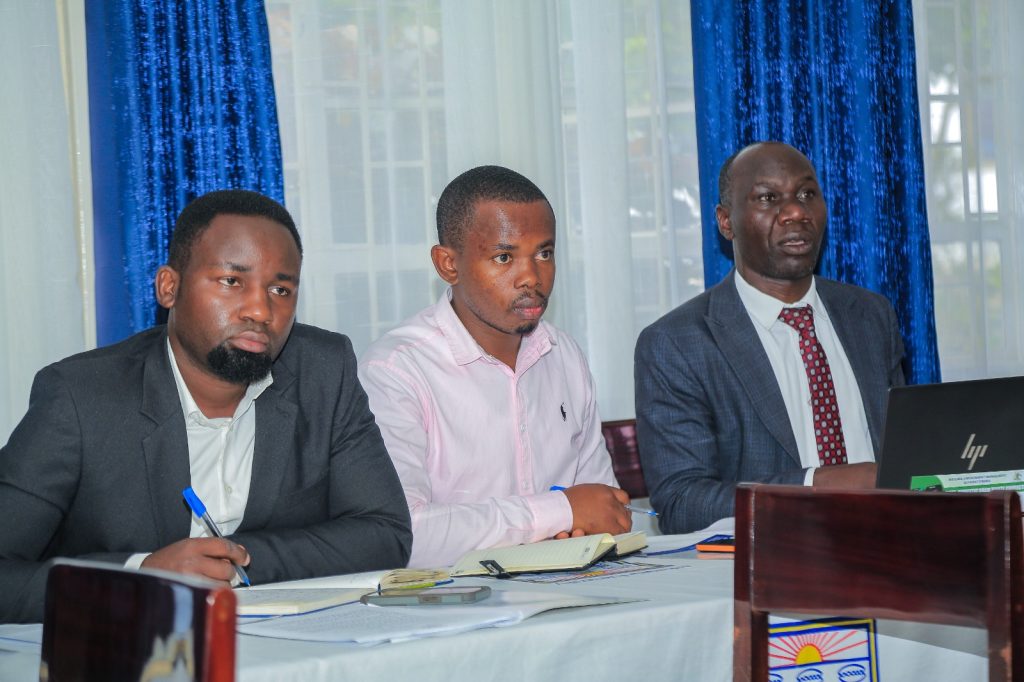
Dr. Richard Komakech described the visit as a significant milestone for collaboration between regulators and academic institutions. “It is my first time at Nkumba University, and I must say we are proud to be associated with an institution that has grown into a great centre of learning,” he said.
He confirmed that NEMA would fast-track drafting a Memorandum of Understanding (MoU) to formalize cooperation between the two institutions. “Universities hold the greatest intellectual resource for environmental research,” Dr. Komakech said. “NEMA is working with universities across the country to develop frameworks for collaboration, and this MoU will form the foundation of our joint operations.”
He added that the authority’s research and innovation unit would work closely with Nkumba researchers to jointly compete for international research grants, noting that modern funding increasingly favors institutional partnerships rather than individual applicants.
NEMA officials also highlighted opportunities for collaboration in environmental education, awareness campaigns, and community outreach programs.
According to Dr. Komakech, NEM